
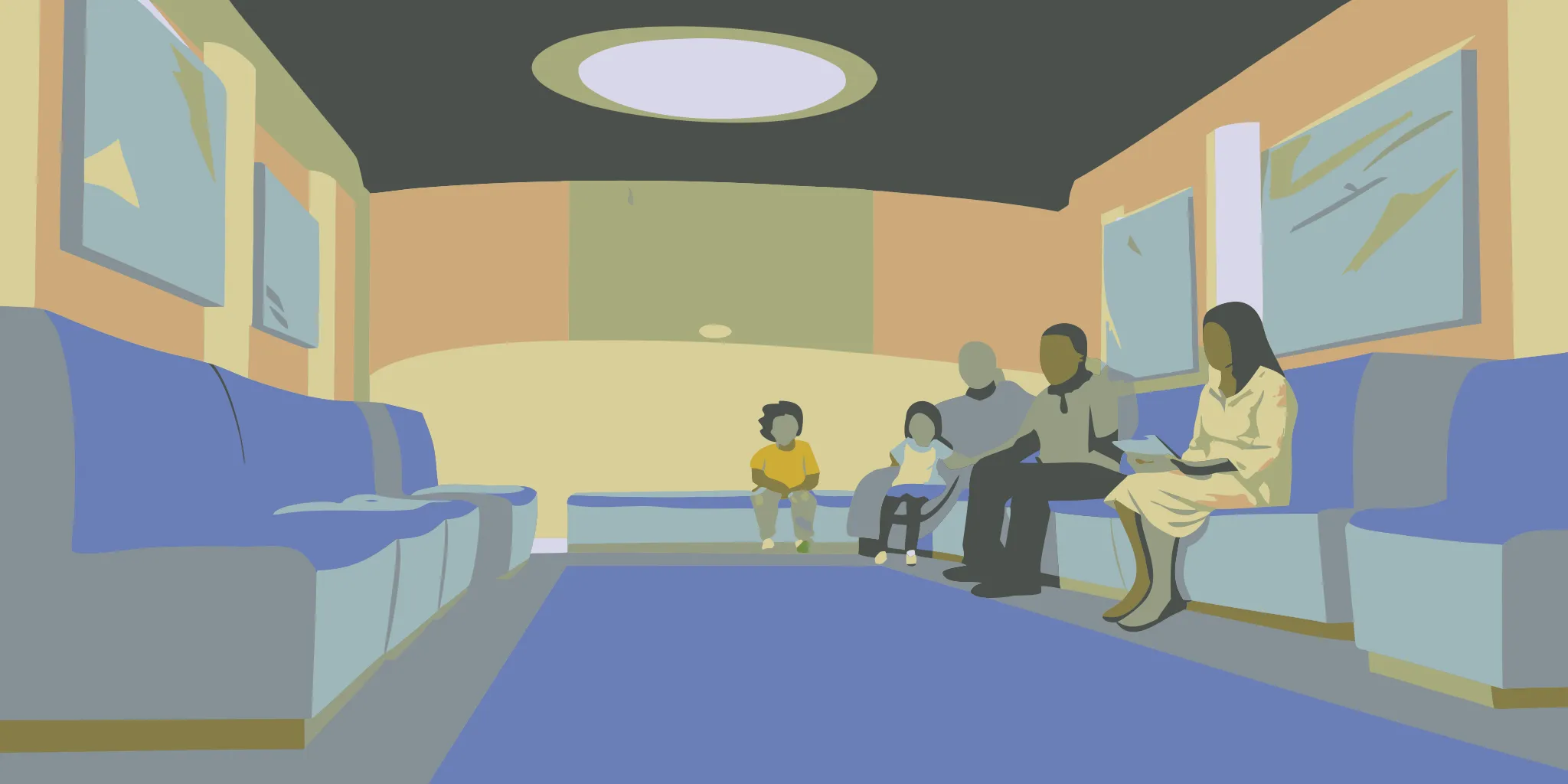
For media buyers and brand managers accustomed to digital attribution models, the physician’s office may seem like an unlikely advertising channel. But the data tells a different story. Patients spend an average of 60 to 240 minutes per medical visit, much of that time in waiting and exam rooms with few distractions. This high-dwell, captive environment is one of the last untapped opportunities for brands seeking meaningful engagement beyond the digital feed.
Ready to reach captive patients where they already spend their time? Explore All Points Media’s healthcare advertising network and build a campaign tailored to your audience.
Doctors office advertising places brand messaging in waiting rooms, exam rooms, and other high-visibility zones within physician practices. With dwell times of 60 to 240 minutes per visit and patients in a health-focused mindset, this channel delivers engagement that digital ads cannot replicate. All Points Media specializes in building custom place-based networks across 3,521 physician locations nationwide, handling every step from venue selection through installation and proof-of-performance reporting.
Why Doctors Office Advertising Works: The Captive Audience Advantage
Physician office advertising succeeds because patients are literally a captive audience. Unlike outdoor billboards or digital ads competing for split-second attention. Medical waiting rooms offer 15 to 20 minutes of idle viewing time, and exam room placements extend that engagement further. The result is deeper brand recall in a setting where patients are already oriented toward health-related decision-making.
High Dwell Times and Deep Engagement
Doctors office advertising captures attention during the one part of a patient’s day when screens and notifications take a back seat. A typical medical visit includes 15 to 20 minutes in the waiting room followed by additional time in the exam room. Across All Points Media’s healthcare network, patients spend between 60 and 240 minutes per visit in a receptive, low-distraction environment.
This extended dwell time translates directly to engagement metrics that outpace most digital channels. A patient glancing at a wallboard or digital display in a waiting room is not multitasking. Research published by the National Institutes of Health confirms that audiovisual aids in primary care waiting rooms effectively communicate health information and can shape patient perceptions. For brands, this means the message lands in a context where the viewer has time to process it.
The Health-First Mindset
When patients walk into a clinic, they are actively thinking about their well-being. This health-first orientation makes them more receptive to products and services positioned within that context. Healthcare and CPG brands alike use clinic-based placements to engage consumers at the precise moment health needs are top of mind.
The setting also circumvents the banner blindness and ad fatigue that plague digital channels. A physical display in a medical office does not compete with an Instagram feed or a YouTube pre-roll. It exists as part of the environment, perceived not as an interruption but as information. That contextual relevance drives both recall and trust.
Building Trust Through Context
Placement context confers credibility. An advertisement appearing in a medical office inherits the trust patients place in their healthcare providers. This is especially valuable for pharmaceutical brands, medical device companies, and health-focused CPG products, where consumer skepticism is typically high. By associating with the clinical environment, brands benefit from the implied endorsement of the setting itself.
All Points Media constructs custom networks that place messaging across the full patient journey from waiting room to exam room. This sequenced exposure reinforces the brand message at multiple touchpoints during a single visit, building recognition without the friction of digital retargeting.
Types of Placements in Medical Waiting Rooms and Exam Rooms
Medical venue advertising spans multiple physical formats and points of contact. Wallboards and digital screens in waiting rooms capture broad attention during idle time. Exam room posters and exam-table paper ads target patients during the private consultation phase. Take-one cards and pharmacy bag ads extend the message beyond the visit itself, creating a bridge between clinical care and post-visit action.
The range of available placement types allows brands to design a multi-touch campaign that follows the patient from check-in to checkout. All Points Media works with advertisers to select the optimal mix based on campaign objectives, audience profile, and desired frequency.
Waiting Room Wallboards and Digital Screens
Waiting rooms are the primary point of entry and typically the longest single dwell period of the visit. Large-format wallboards and digital place-based displays command attention while patients and their companions wait. Content can rotate between brand messaging, health education, and local information, keeping the display fresh across multiple visits.
Research on health communication in waiting rooms demonstrates that patients actively engage with visual materials during the pre-consultation phase. This makes the waiting room an ideal environment for awareness-building campaigns and public health messaging.
Exam Room Posters and Exam-Table Paper
The exam room offers a more private, focused setting for detailed messaging. Posters positioned on walls remain visible throughout the consultation, and branded exam-table paper places the advertisement directly in the patient’s line of sight. These placements are particularly effective for prompting patient-physician dialogue about specific treatments or health management tools.
Because the exam room is where clinical decisions are discussed, advertisements here benefit from high relevance. Patients who see a product in this setting are more likely to ask their provider about it, creating a direct bridge from advertising to action.
Take-One Cards and Pharmacy Bag Ads
Not all medical office placements are stationary. Take-one cards at the front desk allow patients to bring information home, making them effective for coupon offers, appointment reminders, or educational content. Pharmacy bag ads reach patients at the final touchpoint of their visit, reinforcing the message as they prepare to leave.
These tangible formats extend campaign reach beyond the clinic walls. A branded pharmacy bag or informational card becomes a physical reminder that lives in the patient’s home, sustaining awareness long after the visit ends.
| Placement Type | Location | Format | Viewing Window | Optimal Use Case |
|---|---|---|---|---|
| Wallboards | Waiting Room | Large-format print or digital | 15-20 minutes | Brand awareness, health education |
| Digital Screens | Waiting Room | Rotating digital displays | 15-20 minutes | Dynamic content, seasonal campaigns |
| Exam Room Posters | Exam Room | Large-format print | 10-15 minutes | Treatment education, condition-specific |
| Exam-Table Paper | Exam Room | Branded paper roll | 10-15 minutes | Prompting patient-provider conversations |
| Take-One Cards | Front Desk | Small-format cards | Brief pickup | Coupons, lead generation |
| Pharmacy Bags | Exit / Pharmacy | Branded bags | Post-visit carryover | Prescription adherence, follow-up offers |
Healthcare and CPG Brands: Who Benefits from Physician Office Advertising
Pharmaceutical companies, medical device manufacturers, CPG brands targeting families, and public health agencies all benefit from physician office advertising. The common thread is a need to reach consumers in a trusted, distraction-free environment where health-related decisions are top of mind. Each advertiser type uses a slightly different mix of placements and messaging to achieve its specific objectives.
Pharmaceutical and Healthcare Brands
For drug makers and medical device firms, the physician’s office is the natural point of connection with their end user. Patients in waiting and exam rooms are actively considering their health, making them more receptive to information about treatment options and disease management. The clinical setting also lends credibility to health claims that might face skepticism in other media.
All Points Media helps healthcare brands select physician practices that align with their target demographic, ensuring that messaging reaches the appropriate patient population. This precision is a significant advantage over broadcast or mass digital approaches, where waste impressions are inevitable. Using targeted place-based healthcare advertising, brands can concentrate spend on the practices where their audience is already present.
CPG and Family-Oriented Brands
Consumer packaged goods companies use medical office placements to reach parents and caregivers during a health-focused visit. Diaper brands, nutritional products, children’s OTC medications, and household wellness items all benefit from appearing in pediatric and family practice settings. The parent in a pediatric waiting room is actively thinking about family health, creating a natural alignment with wellness-oriented products.
The high dwell time in these settings allows CPG brands to communicate more information than a typical digital or print ad would accommodate. A wallboard in a pediatric waiting room can convey product benefits, usage instructions, and promotional offers without competing for a split-second scroll.
Local Service Providers and Public Health Agencies
Local health departments, school districts, and community-based organizations also find value in medical office advertising. These groups use the channel to disseminate public health information, promote vaccination campaigns, or announce community programs. The credibility of the clinical setting enhances the perceived authority of government and nonprofit messaging.
From a media buying perspective, medical office advertising offers the same geographic flexibility as digital campaigns. Advertisers can target a single practice or scale to a national footprint. All Points Media’s place-based advertising solutions enable this kind of precision without requiring advertisers to manage dozens of individual venue relationships.
Building a Doctors Office Advertising Campaign: A Step-by-Step Guide
Launching a physician office advertising campaign follows a six-step process: define objectives, identify the target audience. Select placement types and venues, develop creative assets, execute installation and management, and measure performance against KPIs. Each stage benefits from the expertise of a full-service partner that handles the logistical complexity of multi-venue deployments.
A successful campaign begins with clarity on the desired outcome. Whether the goal is brand awareness, product education, or direct response, the campaign structure should reflect those priorities from the outset.
Define Your Audience and Objectives
The first step is specifying the target patient population. Different physician specialties attract different demographics. A dermatology practice reaches a different audience than a family medicine clinic or a pediatric office. Mapping audience characteristics to practice types ensures that ad spend reaches the right viewers.
Campaign objectives should also be clearly defined. Awareness campaigns benefit from broad waiting-room visibility, while education-focused campaigns may perform better with exam-room placements that allow for deeper engagement. Setting measurable KPIs at this stage simplifies performance analysis later.
Select Venue Types and Placement Formats
With objectives in place, the next decision is which practice types and placement formats to use. Waiting-room wallboards maximize reach, while exam-room placements offer higher relevance per impression. A combined approach that places messaging at both touchpoints typically delivers the strongest results, since it reinforces the brand message across the full visit duration.
All Points Media’s doctors office advertising network spans 3,521 physician locations, giving advertisers the flexibility to select practices by specialty, geography, patient volume, or demographic profile. This level of curation is not available through traditional OOH vendors.
Develop Creative Assets and Launch
Creative development for medical environments requires a different approach than standard OOH or digital advertising. The clinical setting calls for clean, professional design that communicates value without aggressive sales tactics. Color palettes should complement the medical environment, and copy should prioritize information over hype.
During the build and installation phase, All Points Media manages venue coordination, print production, and on-site installation. This turnkey approach eliminates the operational burden for brands and agencies, who receive a single proof-of-performance report covering all placements.
- Define campaign goals. Establish measurable objectives aligned with brand strategy.
- Identify target audience. Determine patient demographics by practice type and geography.
- Select venue types. Choose practices and placement formats that match campaign goals.
- Develop creative assets. Design materials appropriate for the clinical environment.
- Execute installation. Deploy placements across selected venues with professional setup.
- Measure performance. Review placement data and adjust future campaigns based on findings.
Key Considerations for Medical Environment Advertising
Medical office advertising requires strict adherence to patient privacy standards, sensitivity to the clinical environment, and creative that adds value rather than intrudes. HIPAA compliance is non-negotiable, and messaging should avoid any appearance of tracking personal health data. The most successful campaigns treat the clinical setting as a partnership with the provider, not an interruption of the care experience.
Privacy and Regulatory Compliance
Patient privacy is the foundational requirement for any medical venue campaign. Placements must not collect or imply collection of personal health information. Messaging should be non-intrusive and appropriate for a clinical environment where patients may be experiencing stress or anxiety about their health.
All Points Media ensures that every campaign complies with HIPAA guidelines and respects the patient-provider relationship. Advertising partners are vetted to confirm that their messaging aligns with the professional standards of the medical practices in which it appears.
Creative That Respects the Environment
Effective medical office advertising recognizes that the patient’s primary purpose for being in the office is medical care, not shopping. Creative should provide useful information or solve a problem rather than simply promote. Calm color schemes, clear typography, and informative copy perform better than high-contrast, urgency-driven designs.
Research confirms that patients respond positively to health-related information in waiting rooms. A study on waiting room audiovisual aids found that well-designed materials improve patient knowledge and can influence health behaviors. Brands that align their messaging with this educational function earn higher engagement and recall.
The Value of a Turnkey Partner
Managing a multi-location medical office campaign involves venue identification, contract negotiation, print production, installation scheduling, and ongoing maintenance. Most brands and agencies lack the internal resources to handle these logistics at scale. A full-service partner like All Points Media simplifies the process by serving as a single point of contact from strategy through performance reporting.
This model allows media buyers to treat medical office advertising as a single line item in their media plan. With predictable costs and measurable outcomes, rather than a fragmented set of individual venue relationships.
Measuring Success in Place-Based Healthcare Advertising
Success metrics for medical office advertising center on reach (total patient impressions), dwell time (average viewing duration). And engagement indicators such as take-one card pickup rates or post-visit online traffic. Unlike digital channels, place-based media cannot track individual user behavior, but aggregate impression data and proof-of-performance reporting provide reliable campaign-level measurement.
Reach and Impression Metrics
Reach in a medical office campaign is calculated from patient volume data provided by each practice location. Campaigns report total impressions based on verified foot traffic during the placement period. This data enables media buyers to calculate effective CPM and compare the channel’s cost efficiency against other offline and online options.
All Points Media provides detailed placement reports confirming that each advertisement was installed correctly at the specified venue for the agreed duration. This proof-of-performance documentation is essential for agencies that need to demonstrate media delivery to their clients.
Dwell Time as a Quality Signal
The defining advantage of medical office advertising is dwell time. A digital ad may earn a fraction of a second of attention, while a medical office placement commands minutes of sustained viewing. The physician office environment offers the longest continuous viewing window of any place-based media category, with patients spending 60 to 240 minutes on site.
This extended dwell time drives higher message recall and comprehension. For advertisers targeting complex messages such as disease awareness or treatment regimens, the ability to hold a viewer’s attention for multiple minutes is invaluable.
Campaign Optimization and Scaling
Performance data from initial campaigns informs future optimization. Advertisers can identify which practice types, geographic regions, or placement formats delivered the strongest engagement and allocate future spend accordingly. Custom networks can be scaled up or down based on results, making physician office advertising a flexible channel that adapts to campaign performance.
Partner with All Points Media for Doctors Office Advertising
All Points Media brings over 30 years of expertise in place-based advertising to the healthcare vertical, offering end-to-end campaign management across 3,521 physician locations. From strategy and venue selection through print production, installation, and performance reporting, APM handles every detail so brands and agencies can focus on their core objectives.
Full-Service Turnkey Campaign Management
Running a multi-location medical office campaign involves significant logistical complexity. All Points Media manages the entire workflow: venue identification and contracting, custom network design, print and digital production, nationwide installation, campaign oversight, and proof-of-performance reporting. This turnkey place-based advertising model gives advertisers a single point of contact and predictable execution timelines.
- Strategic venue selection based on audience demographics and campaign objectives.
- Custom network design at local, regional, or national scale.
- Full print and digital creative production.
- Professional installation and ongoing maintenance.
- Detailed proof-of-performance reporting.
Scalable Networks Aligned to Your Objectives
Every campaign is built from the ground up to match the advertiser’s specific goals. Whether the target is a single zip code or a national rollout, All Points Media constructs a network that delivers the right reach at the right cost. Campaigns can launch as pilots and scale based on measurable performance data.
Because APM builds custom networks rather than selling from fixed inventory, advertisers are not limited to pre-existing placement packages. This flexibility ensures that every dollar of ad spend is directed toward the highest-value locations for the specific target audience.
Proven Results in High-Engagement Environments
The medical office setting consistently delivers engagement metrics that outperform traditional OOH and digital advertising. Extended dwell times, a health-focused mindset, and the trust conferred by the clinical environment combine to create a uniquely effective advertising channel.
By partnering with All Points Media, brands gain access to a nationwide physician office network managed by a team with three decades of place-based advertising experience. The result is a turnkey campaign that reaches captive patients in a high-trust setting, measured and reported with the rigor that media buyers demand.
Frequently Asked Questions
What is the typical dwell time for doctors office advertising?
Patients and their companions typically spend 60 to 240 minutes in a physician’s office per visit, including check-in, waiting room time, and the consultation itself. The waiting room alone accounts for 15 to 20 minutes of idle viewing time, during which wallboards and digital displays capture sustained attention. This extended dwell window is one of the longest in place-based media and a primary reason advertisers invest in the channel. For a breakdown of typical costs and budgeting considerations, read our guide to how much to advertise in doctors offices.
Can doctors office advertising campaigns be scaled nationally?
Yes. All Points Media’s physician office network spans 3,521 locations across the United States, supporting local, regional, and national campaign structures. Advertisers can launch simultaneously across all locations or phase in markets over time. Custom network design ensures that each campaign’s geographic footprint matches its target audience distribution.
How do medical venue placements help brands avoid digital fatigue?
Digital advertising faces increasing consumer resistance through ad blockers, subscription-based ad-free tiers, and banner blindness. Medical office advertising operates in a physical environment where patients cannot mute, skip, or block the message. This forced attention, combined with the health-focused mindset of the viewer, creates engagement that digital channels cannot replicate.
What types of brands benefit most from physicians office advertising?
Pharmaceutical companies, medical device manufacturers, health-focused CPG brands, public health agencies, and local service providers all see strong returns from physician office advertising. The common requirement is a message that resonates with patients during a health-oriented visit. Brands with educational or awareness-based objectives typically see the highest engagement.
What services are included in a turnkey doctors office advertising campaign?
A turnkey campaign from All Points Media includes strategic venue selection, custom network design, print and digital production, nationwide installation, campaign management, and proof-of-performance reporting. The advertiser works with a single point of contact throughout the campaign lifecycle, eliminating the operational burden of managing individual venue relationships.
Ready to build a doctors office advertising network for your brand?
Every day your brand is absent from the physician’s office is a day your competitors could be building relationships with patients who are ready to engage. With 3,521 physician locations ready for custom placement and a team that has managed place-based campaigns for three decades. All Points Media makes it straightforward to launch a campaign that reaches captive patients in a high-trust environment.
Contact All Points Media today to start building your doctors office advertising network.