
Modern consumers spend most of their waking hours avoiding ads. They pay monthly premiums for ad-free streaming tiers, install script-blocking browser extensions, and reflexively look at their phones the second a commercial starts. This mass digital fatigue has triggered a major renaissance in physical, real-world advertising formats. Global out-of-home (OOH) ad spend is projected to surpass $71.5 billion by 2030 as brands seek reliable ways to reach audiences beyond the reach of ad blockers. Yet when most marketing professionals think of outdoor advertising, they default to one image: the massive roadside billboard.
While traditional billboards have dominated the outdoor landscape for nearly a century, they suffer from structural, psychological, and financial limitations that modern campaigns cannot afford. Today, savvy media buyers are turning to alternative out of home advertising to capture attention where traditional signs fall short. By placing brand messages directly into high-dwell, low-distraction physical environments, alternative OOH solves the biggest problems of modern marketing: ad avoidance, audience distraction, and wasted spend.
This article breaks down the metrics, psychology, and practical advantages of alternative out-of-home media compared to roadside billboards, with actionable insight for media buyers building their next campaign.
Ready to build a place-based campaign that reaches your exact audience? Explore All Points Media’s alternative out of home advertising solutions and start targeting consumers where they live, work, and play.
What Is Alternative Out of Home Advertising? A Definitions-Driven Overview
Alternative out of home advertising is a category of OOH media that places brand messages inside physical venues where consumers naturally spend extended time. Rather than alongside highways or on street furniture. Unlike traditional billboards that target drivers in motion, alternative OOH reaches people who are stationary, relaxed. And receptive in environments such as fitness centers, medical offices, community venues, transit hubs, and retail locations. The key differentiator is dwell time: where a billboard earns three seconds of fractured attention, place-based media captures audiences for 60 to 240 continuous minutes per visit. This shift in audience psychology transforms how brands can communicate, educate, and convert.
The Fatal Flaw of Roadside Billboards: The 3-Second Driving Window
Roadside billboards suffer from a fundamental, unchangeable physical limitation: speed. When an advertisement is placed along a highway or busy metropolitan artery, the audience is moving past it at 45 to 70 miles per hour.
In the outdoor industry. Designers must build static roadside creative around the “3-second rule.” This guideline dictates that a driver has a window of only three seconds to safely notice. Read, and comprehend a billboard’s message. To accommodate this tiny attention span, copy must be restricted to six words or fewer, and visual designs must be extremely basic. There is zero opportunity for storytelling, educational positioning, or complex calls to action. A motorist simply cannot register details while navigating traffic.
Furthermore, roadside signs are highly vulnerable to visual clutter. Your message competes with other billboards, traffic signals, road signs, and the cognitive load of driving itself. This high-distraction environment results in a high percentage of wasted impressions — views that technically occurred but left no cognitive footprint.
Key takeaway: The 3-second driving window means roadside billboards are limited to basic brand awareness. They cannot educate, differentiate, or drive considered action. Alternative OOH solves this by putting your message in front of stationary audiences with ample time to engage.
What Makes Alternative OOH Different? Captive Audiences and Extended Dwell Times
Alternative out-of-home advertising — often called place-based media — turns the traditional OOH model on its head. Instead of targeting drivers moving at high speeds, alternative OOH positions your brand directly in front of people during their daily routines when they are stationary and receptive.
By placing static or digital media in environments where consumers naturally spend time, brands can access unparalleled dwell times. While a billboard gets three seconds of fleeting attention, alternative OOH networks routinely deliver 60 to 240 minutes of continuous dwell time. Consider the difference in consumer psychology across common venue types:
- Medical and dental offices: Patients sit in waiting rooms or exam rooms for 30 to 45 minutes with minimal distraction, naturally scanning their immediate surroundings at eye level.
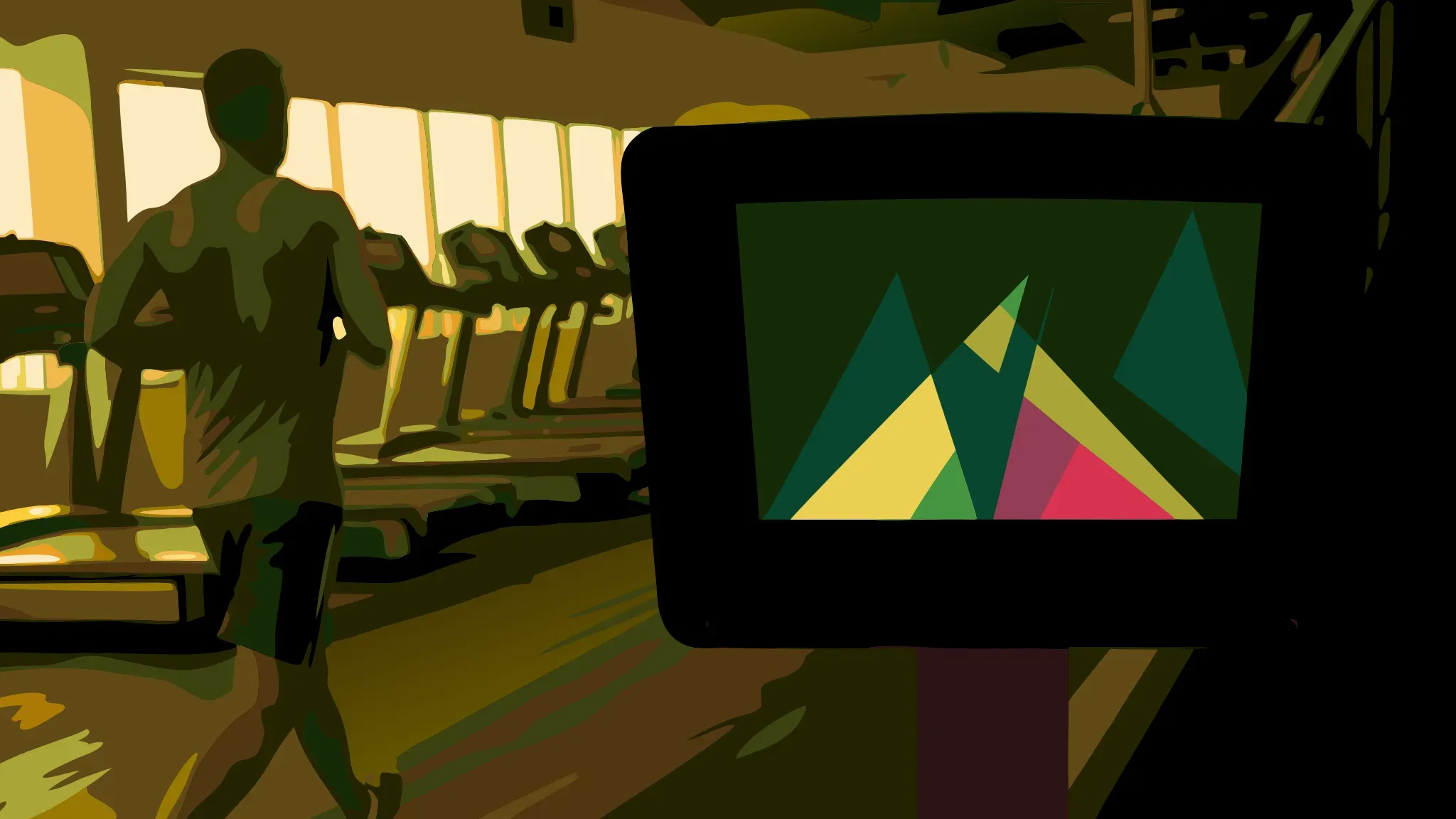
- Fitness centers and health clubs: Members spend 60 to 90 minutes working out, repeatedly viewing wall displays, digital screens, and convenience posters during rest intervals and equipment rotations.
- Community and recreation centers: Families gather for events, classes, and open recreation for extended periods, absorbing local displays in trusted, positive social spaces.
- Transit hubs and commuter stations: Daily commuters pass through the same spaces for 20 to 40 minutes each way, building familiarity and message retention over repeated exposures.
- Retail and service businesses: Customers waiting for appointments, services, or checkout have natural downtime that place-based media fills productively.
These extended dwell times mean your creative no longer needs to be stripped down to a single sentence. You can explain product benefits, introduce complex services, tell a brand story, and present clear, scannable QR codes or interactive prompts that drive immediate action. For brands looking to maximize engagement, utilizing place-based media alternatives is one of the most effective ways to turn passive views into active conversions.
How Do Custom Networks Compare to Fixed-Inventory Billboard Sales?
Another critical difference lies in how traditional and alternative advertising networks are bought and built. Traditional outdoor media agencies operate on a rigid, fixed-inventory sales model. They own specific steel-and-wood structures along highway routes. And your job as the marketer is to select from their pre-existing list — even if those locations do not perfectly align with your target demographic.
This fixed-inventory model often forces brands to pay high premiums for traffic that has no interest in their product simply because that billboard happens to sit on a high-volume route. It is a scattershot approach that prioritizes raw, unsegmented volume over audience quality.
Elite alternative OOH operators like All Points Media operate on a completely different philosophy: bespoke, custom-built networks. Rather than forcing you to buy pre-existing boards. APM leverages its massive nationwide network of over 100,000 leased venues across 50-plus unique categories to build a network tailored specifically to your campaign goals.
If you want to reach high-income athletic mothers, your ads are placed in premium tennis and athletic clubs. If you need to target pediatric healthcare decision-makers, your media is deployed in family medical practices. This custom approach ensures minimal waste: you are paying to place media in front of the exact demographic you need to reach. Across any of the 210 US DMAs. Learn more about how All Points Media builds custom venue networks for targeted campaigns.
Key takeaway: Custom networks deliver precision targeting that fixed-inventory billboard models cannot match. Every dollar spent reaches a predefined audience profile, not just whoever happens to drive past.
50-Plus Venue Categories vs. Limited Roadside Placements
Traditional billboard providers are severely limited in where they can legally and physically place their inventory due to local zoning laws, highway regulations, and real estate availability. This restricts their offerings to a handful of standard formats: highway bulletins, urban posters, and basic transit shelters.
In contrast, alternative OOH offers almost limitless physical variety. All Points Media boasts over 50 venue categories, compared to the 5 to 15 offered by typical outdoor agencies. This vast selection allows marketers to choose the perfect physical medium to match their creative concept. Here is how the two models compare across key campaign dimensions:
| Campaign Attribute | Traditional Highway Billboards | All Points Media Alternative OOH |
|---|---|---|
| Average Dwell Time | 3 to 5 seconds | 60 to 240 minutes |
| Audience Psychology | Distracted (driving, navigating traffic) | Captive, relaxed, and receptive |
| Inventory Model | Rigid, fixed-location structures | Bespoke, custom-built venue networks |
| Venue Diversity | Highway sides and roadside easements | 50-plus categories (fitness, medical, retail, transit, community) |
| Proof of Performance | Traffic estimates and modeled circulation data | 100 percent photo-documented verification |
| Creative Flexibility | Standard square or rectangular static panels | Digital screens, convenience posters, floor graphics, branded products, experiential takeovers |
| Geographic Targeting | Along specific highway corridors | 210 US DMAs with hyper-local venue placement |
With APM, your brand is not restricted to a standard layout. You can deploy convenience posters, digital place-based screens, floor graphics, custom-branded products, or entire experiential takeovers within highly trusted local environments. This diversity allows your brand to match the physical medium to the consumer’s mindset, creating a cohesive, immersive experience that roadside billboards can never replicate.
Is Alternative OOH More Accountable? The Verification Gap
Historically, one of the biggest frustrations for outdoor media buyers has been verification. When you purchase a highway billboard, you are often relying on outdated traffic estimates, modeled circulation data. Or the word of the local provider that your sign was printed and hung correctly. If a roadside billboard is blocked by overgrown foliage, damaged by a storm. Or suffers a digital screen outage, it can take days or weeks for the issue to be noticed and reported. The buyer absorbs the waste without recourse.
Alternative out-of-home campaigns place a premium on strict accountability. Because place-based media operates inside managed, leased spaces, execution can be tracked with extreme precision. All Points Media has spent over 30 years perfecting a turnkey campaign execution model that prioritizes client trust. Every single placement in an APM network is verified with 100 percent photo-documented proof-of-performance. Marketers receive clear, high-resolution photographs of their media installed live in each specific venue, ensuring absolute transparency.
The operational model is designed for simplicity: one partner, one detailed invoice, and complete physical confirmation of your investment. For media buyers who have been burned by opaque billboard verification, this level of accountability is a structural advantage that transforms how OOH budgets are justified to stakeholders.
What Questions Do Media Buyers Ask About Alternative OOH?
How much does alternative out of home advertising cost compared to billboards?
Cost structures differ because the models are fundamentally different. Billboard pricing is driven by traffic volume (daily vehicle counts) and location prestige, with prime highway units commanding premium rates regardless of audience fit. Alternative OOH pricing is based on venue type, network size, and campaign duration, often delivering more competitive cost-per-impression because the audience is targeted rather than incidental. A custom network avoids paying for the millions of untargeted views a billboard generates.
What types of businesses benefit most from place-based media?
Any business with a defined target demographic benefits from place-based media, but it is especially powerful for healthcare systems. CPG brands, financial services, higher education, retail chains, entertainment properties, and government agencies. The ability to place messaging inside venues where the target audience already spends time — medical clinics. Fitness centers, transit hubs, community centers — makes alternative OOH effective for both B2C and B2B campaigns.
How long does it take to launch an alternative OOH campaign?
All Points Media typically launches campaigns within two to three weeks from contract to installation, depending on network size and venue availability. The process begins with a strategy consultation to define audience targets, followed by venue selection, creative production, nationwide installation, and proof-of-performance documentation. This timeline compares favorably to billboard campaigns, which often face zoning delays, permitting issues, and longer production cycles.
Can alternative OOH campaigns target specific geographic areas?
Yes. All Points Media operates across all 210 US DMAs and can build hyper-local networks targeting specific zip codes, metropolitan areas, or regions. This makes alternative OOH suitable for national brand campaigns, regional launches, and local market saturation strategies alike.
Beyond the Roadside: Why Forward-Thinking Brands Are Making the Switch
Traditional roadside billboards will always have a place for broad, high-volume brand awareness campaigns. However, for companies that demand precise demographic targeting, deep consumer engagement, extended dwell times, and verifiable performance, alternative out of home advertising is the superior choice.
The advertising landscape is shifting toward measurable, audience-centric models. Digital ad saturation, rising CPMs. And consumer trust erosion in online channels are driving media buyers back to physical environments — but not to the same old highway boards. The brands winning today are the ones placing their messages inside the gym, the clinic, the community center, and the transit station, where real people spend real time.
By taking advantage of captive environments, extended 60-to-240-minute waiting periods, and bespoke custom networks. You can ensure your advertising dollars are spent on high-value, highly receptive human attention rather than high-speed traffic. It is time to step off the highway and place your brand directly in the path of your customer’s daily life.
Frequently Asked Questions
What is the difference between traditional OOH and alternative OOH advertising?
Traditional OOH includes highway billboards, street furniture, and transit advertising that targets people in motion. Alternative OOH, also called place-based media, places ads inside venues where consumers are stationary and receptive — such as fitness centers. Medical offices, and community venues — delivering dwell times of 60 to 240 minutes compared to the 3-second window of a roadside billboard.
How effective is alternative out of home advertising compared to digital ads?
Alternative OOH reaches consumers in physical environments where digital ad blockers, streaming skipping, and banner blindness do not apply. The captive, low-distraction nature of place-based venues means recall rates are significantly higher than digital display advertising. And the absence of ad fatigue allows brands to communicate more complex messaging without losing audience attention.
Can small businesses afford alternative out of home advertising?
Yes. Because alternative OOH networks are built custom to each campaign, businesses of all sizes can deploy place-based media at budget levels that match their goals. Unlike billboards that require long-term leases on fixed inventory, alternative OOH campaigns can be scoped to specific venue categories. Geographic regions, and campaign durations that fit smaller budgets while still delivering measurable impact.
How do you measure ROI for a place-based media campaign?
All Points Media provides 100 percent photo-documented proof-of-performance for every placement, along with campaign reporting that details venue locations, installation dates, and audience exposure data. For brands seeking deeper attribution, campaigns can incorporate QR codes, unique URLs, and promo codes to track direct response from physical placements.
What venues are available through All Points Media’s network?
All Points Media offers access to over 100,000 leased venues across 50-plus categories, including fitness centers. Medical and dental offices, community and recreation centers, transit hubs, retail locations, family entertainment venues, and more. Each campaign selects venues based on the target audience profile to maximize relevance and engagement.
Ready to design an alternative OOH campaign that delivers absolute accountability and guaranteed engagement? Contact All Points Media to start building your custom, nationwide venue network today.