
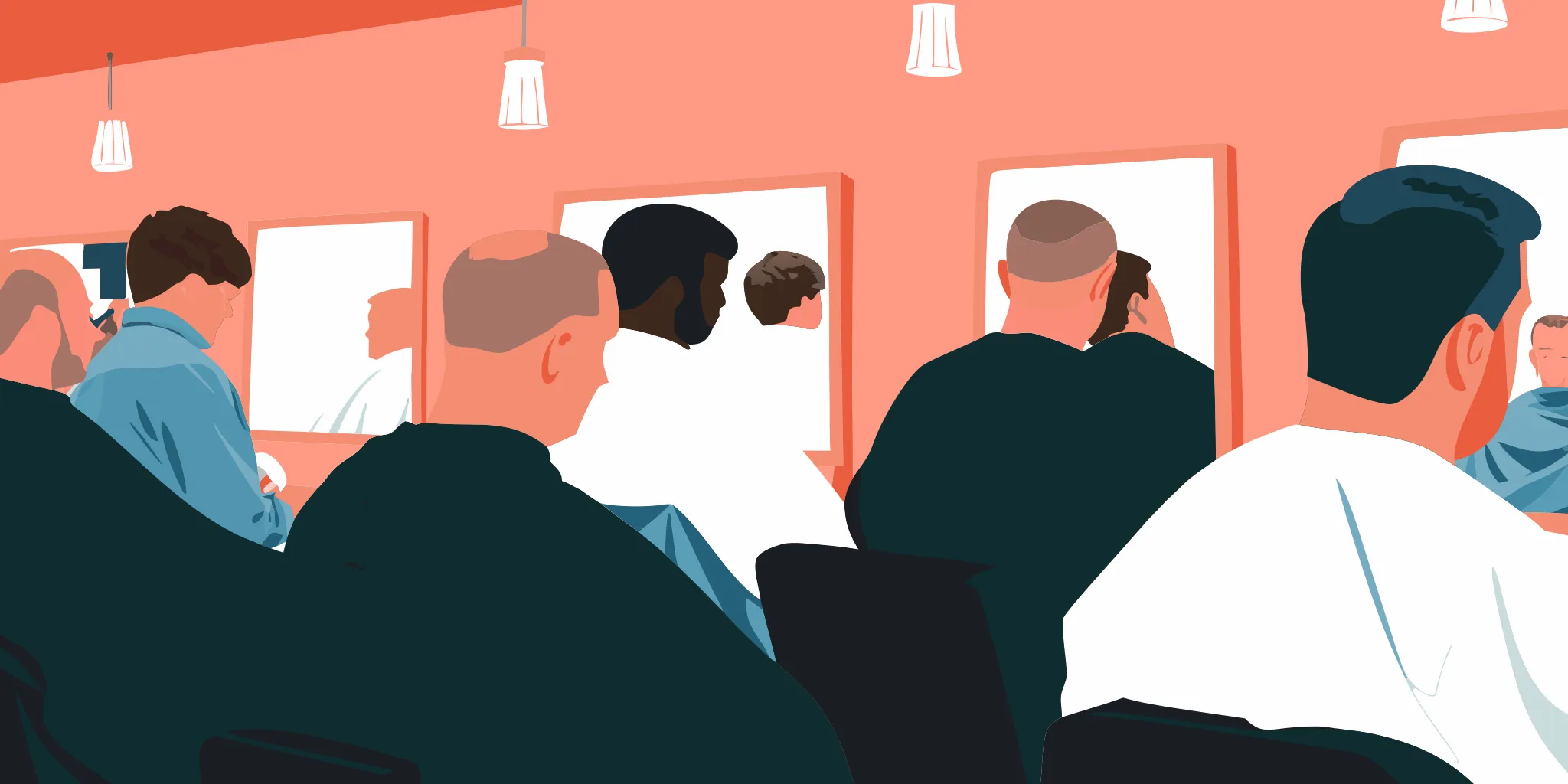
For media buyers, the value of a barber shop extends beyond its neighborhood footprint. A typical grooming visit creates a focused, high-dwell setting where consumers are already settled in one place, away from the rapid exposure cycle of roadside or mobile inventory. That makes the environment well suited to brand messages that benefit from repeated, contextual visibility.
Barber shop advertising uses the 30- to 60-minute grooming visit to reach male consumers in a low-distraction environment. With All Points Media able to build custom networks across 1,750+ barber shop locations rather than rely on fixed inventory.
For agencies planning local, regional, or national campaigns, the opportunity is to treat these businesses as coordinated place-based media rather than isolated placements. The combination of dwell time, community relevance, and scalable venue selection creates a strong foundation for evaluating how barber shops can complement a broader out-of-home strategy.
Why Barber Shops Are a Prime Opportunity for Place-Based Advertising
Answer: Barber shops give brands access to a captive audience during a 30- to 60-minute grooming visit. That extended window creates more time for meaningful exposure than many fast-moving media environments. Their community role, low-distraction setting, and scalable inventory make them a strong foundation for a barber shop advertising campaign.
For media buyers, dwell time is a practical advantage. Customers typically remain in the shop while receiving a haircut, shave, or other grooming service, rather than passing a placement in a matter of seconds. That extended window gives creative more opportunity to be seen, understood, and connected to the surrounding experience. It can be especially useful for brands whose message benefits from context, repetition, or a clear call to action.
Barber shops also function as community staples. They are familiar neighborhood businesses with a social history that extends beyond the transaction itself. Customers may return regularly, discuss local topics, and build relationships with barbers and other patrons. For advertisers, that environment can make a message feel more relevant to the audience and the market, particularly when venue selection is aligned with geographic or demographic priorities. The community role of barbershops is also documented by Epos Now.
A captive audience without digital-feed clutter
Unlike a crowded digital feed, a barber shop can offer a lower-distraction environment for physical brand messaging. Customers are already engaged in a personal-care moment, with fewer competing screens and notifications demanding attention. That does not guarantee a particular outcome. But it creates favorable conditions for brand recall and message recognition when the placement and creative are well matched to the venue.
Scale across a relevant venue network
All Points Media has access to more than 1,750 barber shop locations, allowing advertisers to build a network around a local market, regional footprint, or broader campaign objective. The value is not simply the number of venues. A curated network can help extend a consistent message across communities while preserving the proximity and familiarity that make place-based media distinctive. Explore the barber shop advertising network to see how these placements can support a broader alternative OOH strategy.
Male Consumer Demographics: Who You Reach in Barber Shops
Answer capsule: Barber shop advertising gives media buyers access to a broad male audience, from 18 to 65 and across income levels. Because many customers return weekly or every two weeks, a strategically selected network can build recurring exposure among consumers during a familiar, high-dwell grooming occasion.
Barber shops offer a practical way to reach male consumers without treating them as a single, narrow segment. The audience spans men ages 18 to 65, including younger adults establishing routines, working professionals, parents, and older customers who maintain regular grooming habits. That breadth gives planners room to align the venue network with a brand’s actual customer profile rather than relying on broad demographic assumptions.
Income diversity is another important planning consideration. Barber shop customers represent all income levels, making the channel relevant for more than premium grooming or lifestyle brands. Financial services, healthcare, retail, entertainment, automotive, food and beverage, and consumer packaged goods advertisers can all evaluate the environment based on location, customer mix, and campaign objective.
Reach customers through recurring visits
Frequency is built into the venue behavior. Regular customers commonly visit weekly or bi-weekly, creating repeated opportunities for a message to be seen over time. This cadence can support sequential creative, seasonal promotions, or a consistent brand platform. It also makes barber shops useful for campaigns that need reinforcement rather than a single exposure.
Plan around measurable venue exposure
Each location generates 12,000 or more impressions per four weeks. That planning benchmark helps media buyers estimate potential delivery at the venue level and compare a barber shop network with other place-based options. Actual exposure will depend on the selected locations and campaign execution, so the figure should serve as a network-planning input, not an automatic performance guarantee.
The strongest strategy is to curate locations around the audience, geography, and desired scale. A regional campaign may prioritize neighborhood density and market coverage, while a national brand may use a larger network to create consistent presence across multiple DMAs. In both cases, recurring visitation and broad male reach make the channel a useful complement to digital, video, and traditional out-of-home media.
Advertising Formats That Work in Barber Shops
Answer: Barber shop advertising can combine eye-level mirror clings, wall-mounted displays, counter cards, posters, waiting area signage, and restroom boards. Each format gives media buyers a different way to balance visibility, dwell time, creative detail, and placement context within the same grooming environment.
All Points Media can build a format mix around the way customers move through each shop, rather than treating every venue as interchangeable. That distinction matters because a message seen in the mirror, encountered while checking in, or viewed during a wait has a different role in the media plan.
Mirror clings for eye-level engagement
Mirror clings put the message directly into a customer’s line of sight during the service. The 3-by-3-inch format is compact, making it suitable for eye-level placement without overwhelming the mirror or competing with the barber’s work. It can support a concise offer, brand cue, QR code, or product message when the creative is designed for quick recognition. See examples of mirror cling advertising in barber shops when evaluating how this placement can work in practice.
Wall and waiting-area placements
Wall-mounted displays and acrylic or poster holders provide more room for visual storytelling than a mirror cling. They are useful for brand imagery, service education, seasonal campaigns, or messaging that benefits from a little more reading time. Posters can work in the same inventory family, provided the design uses a strong hierarchy and remains legible from the expected viewing distance.
Waiting area signage extends that opportunity to customers who arrive early or spend time between appointments. It can reinforce a message already introduced elsewhere in the shop, or carry a standalone creative concept. For broader planning considerations, media buyers can also review salon and barber shop advertising strategies.
Counter displays and restroom boards
Counter displays meet customers at practical touchpoints such as check-in, payment, or product browsing. They are well suited to a direct response prompt, a nearby offer, or a message that benefits from being physically close to the point of action.
Restroom boards provide another controlled viewing environment. Because the audience is stationary and the placement is separate from the main service area. The format can carry a slightly more detailed message while still keeping the visual execution clean. A coordinated campaign can use the mirror for recognition, the wall for context, and counter or restroom placements for reinforcement. The result is a deliberate sequence of brand exposures, not a collection of disconnected signs.
Barber Shop Advertising vs. Traditional Out-of-Home
For media buyers, the distinction is not simply where an ad appears. It is how long the audience can engage, how precisely the network can be built, and how clearly the campaign can be verified. Barber shop advertising gives brands a place-based option that complements broader OOH while creating a more focused consumer moment.
| Campaign factor | Barber shop advertising | Traditional OOH |
|---|---|---|
| Audience attention | A captive, low-distraction audience encountered during a grooming visit, allowing messaging to occupy a meaningful consumer moment. | Often a fleeting impression consumed while people travel past a roadside, transit, or other high-traffic placement. |
| Network design | A custom network can be built around the advertiser’s audience, geography, and campaign goals rather than limited to fixed inventory. Hyperlocal barber shop advertising can support market-specific planning. | Inventory is typically selected from established locations and formats, which can provide scale but may offer less flexibility in venue composition. |
| Dwell time | Customers may spend approximately 30 to 60 minutes in the shop, creating more opportunity for repeated or longer-form exposure. | Exposure commonly lasts seconds as audiences pass a display or move through a public environment. |
| Execution | All Points Media can manage strategy, venue procurement, creative production, installation, and campaign coordination through a turnkey model. | Execution may involve separate vendors or processes for planning, production, placement, and market-level coordination. |
| Reporting | Proof-of-performance reporting helps document delivery across venue-specific placements and gives media teams a clearer campaign record. | Reporting depends on the format and vendor, with visibility into individual venue delivery varying by campaign. |
The strongest choice depends on the role the channel needs to play in the media mix. Traditional OOH can deliver broad visibility, while a custom barber shop network adds context, dwell time, and hyperlocal precision without requiring the brand to manage venue-by-venue execution independently.
How to Build a Barber Shop Advertising Campaign
A strong campaign starts with the audience and ends with accountable execution. The process below turns a broad media objective into a curated network of barber shops, coordinated creative, and documented delivery.
- Define the audience and campaign objective. Clarify who the brand needs to reach, where those consumers live, and what role barber shop placements should play alongside digital, audio, video, or broader out-of-home media. Set the geographic footprint, timing, budget parameters, message priority, and the action you want consumers to take. If the campaign supports a local offer or booking journey, align the physical message with the brand’s digital experience rather than treating each channel separately.
- Assess the venue opportunity. Determine why barber shops are the right environment for the message. Consider dwell time, audience composition, neighborhood context, shop type, and the relevance of the grooming occasion to the product or service. Community connection and loyalty are important considerations in barber-industry marketing, so venue selection should account for more than a location pin. It should reflect the audience and context the brand wants to enter.
- Curate the network against defined criteria. Build the placement list around the brief, not around leftover inventory. Evaluate venues by geography, audience fit, scale, format availability, and campaign objectives, then organize the mix into a coherent national, regional, or local network. A structured curation process makes it easier to balance reach with relevance and to explain why each venue belongs in the plan.
- Develop creative for the barber shop environment. Adapt the message to the selected formats, including mirror placements, wall displays, counter materials, or waiting-area signage. Creative should be legible at the expected viewing distance, work within the shop’s visual environment, and communicate one clear idea. Use a concise call to action, a memorable visual system, and a destination that is easy to access from a mobile device.
- Produce and install at the required scale. Coordinate specifications, approvals, production, shipping, and installation across the network. All Points Media’s turnkey model covers strategy, venue procurement, creative production, installation, and reporting, keeping operational ownership in one workflow (All Points Media campaign services). For multi-market programs, centralized production helps maintain consistency while local installation teams handle venue-specific requirements.
- Manage the campaign and document delivery. Monitor timing, venue participation, creative condition, and installation status throughout the flight. Close the loop with proof-of-performance reporting that records where the campaign ran and how delivery was confirmed. This gives media buyers a defensible record of execution and creates a practical basis for optimizing the next barber shop advertising campaign.
Why All Points Media Leads in Barber Shop Advertising
All Points Media brings more than 30 years of out-of-home expertise to barber shop advertising, with experience dating back to 1995. That institutional knowledge matters when a campaign must move beyond a few individual placements and operate as a coordinated media network. Rather than forcing a brand into fixed inventory, All Points Media builds a custom network around the audience, geography, scale, and campaign objectives.
The company has access to more than 100,000 leased venues across 50+ categories, creating breadth without losing the ability to curate the right locations. Its operations span all 50 states and 210 designated market areas, supporting local, regional, and national planning from a single partner. For media buyers, that means barber shops can function as a deliberate extension of a broader place-based media strategy. Not an isolated test disconnected from the rest of the plan.
All Points Media also controls key execution steps in-house. APM PrintWorks manages production, while AP Installations supports nationwide installation. This vertically integrated structure helps keep creative specifications, production quality, placement standards, and rollout timing aligned across a distributed network. It also reduces the operational burden on agencies managing campaigns across multiple markets.
Custom networks built for the campaign
Every barber shop audience is not interchangeable. A campaign may need a concentrated urban footprint, a multi-market rollout, or a carefully selected mix of neighborhoods and venue profiles. All Points Media evaluates those requirements and assembles the network accordingly, instead of selling a predetermined list of locations. That flexibility makes the medium more useful for precise audience planning and market-level activation.
Turnkey execution with accountable delivery
From venue procurement and production through installation and proof-of-performance reporting, All Points Media manages the workflow as a full-service partner. Its broader place-based media capabilities give advertisers a way to connect barber shop placements with other high-dwell environments while maintaining one strategic and operational point of contact.
Frequently Asked Questions
What types of brands benefit from advertising in barber shops?
Barber shop placements can suit brands that want to reach adult male consumers in a community-based setting. Common fits include grooming, apparel, automotive, financial services, healthcare, food and beverage, entertainment, retail, and local businesses. The strongest campaigns align the offer, creative, and geographic footprint with the audience and context of the selected shops.
Which advertising formats work best in barber shops?
The right format depends on where consumers spend attention during the visit. Mirror clings can deliver eye-level exposure during the service, while wall displays, counter signage, waiting-area placements, and restroom boards support repeated visibility in different parts of the venue. Creative should be simple, visually strong, and easy to understand at a glance.
Can a barber shop campaign target specific markets?
Yes. A network can be curated around a national, regional, local, or hyperlocal objective. Venue selection may consider geography, neighborhood characteristics, shop type, audience fit, and campaign scale. This approach lets media buyers build a more relevant footprint than placing the same message across every available location.
How is campaign performance documented?
Campaign planning should establish the reporting requirements before installation. All Points Media can manage execution from venue coordination and production through installation and proof-of-performance reporting. The final reporting approach depends on the selected placements, campaign scope, and documentation available from participating venues.
How do I get started with a barber shop advertising campaign?
Start by defining the audience, markets, campaign timing, offer, and desired action. All Points Media can then assess the brief, curate an appropriate barber shop network, recommend formats, coordinate production and installation, and establish the reporting plan before launch.
Contact us to build your barber shop network
All Points Media can help translate your audience strategy into a custom barber shop advertising network, with placements designed for the attention available during grooming visits. Contact All Points Media to discuss your campaign goals, market priorities, and the right venue mix. Contact All Points Media to get started.