
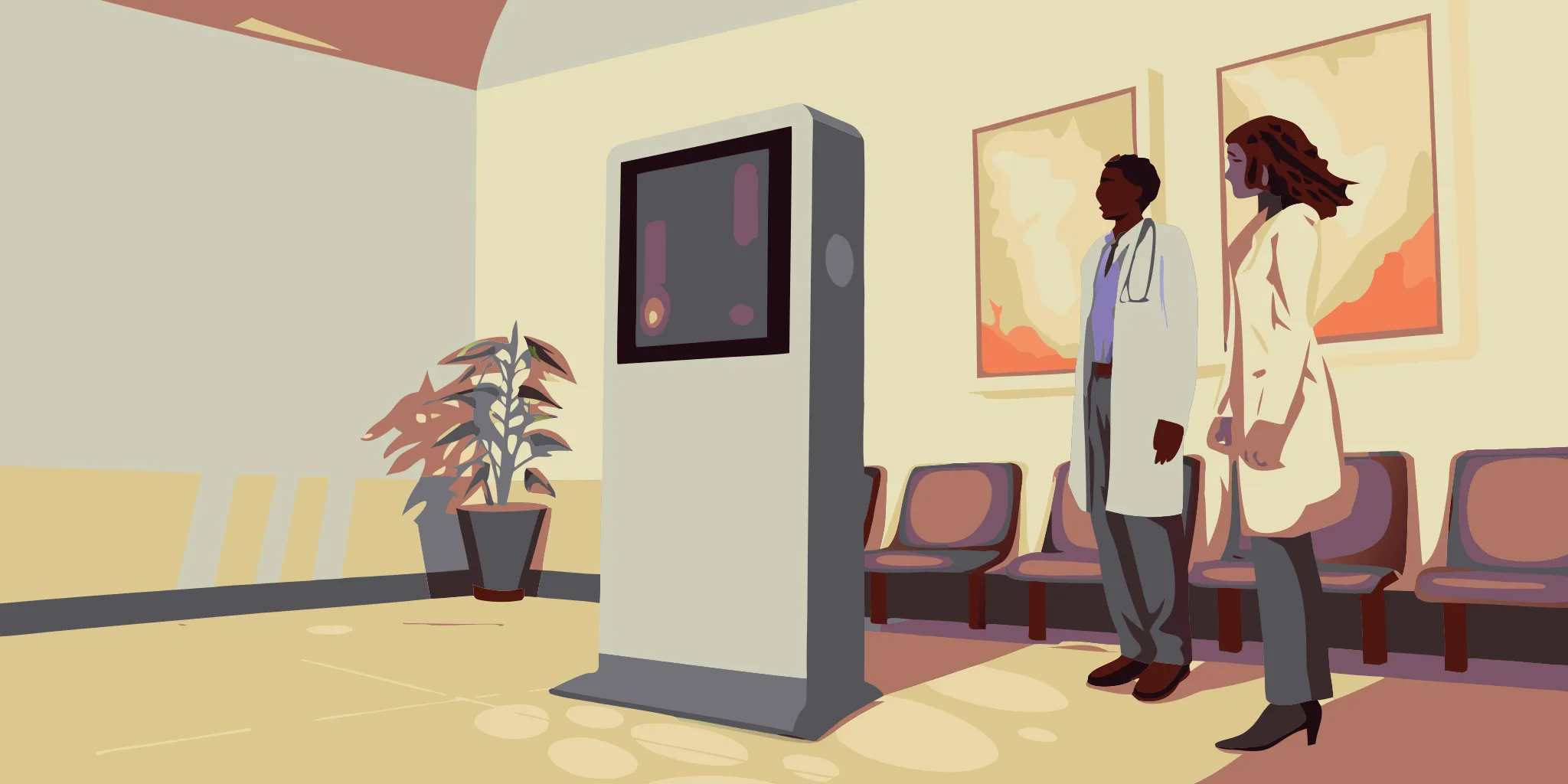
When evaluating ‘point-of-care advertising companies’, it’s easy to get impressed by massive network numbers. But reach is only half the story. A network of a million screens is meaningless if they aren’t in the right venues to connect with your specific audience. The success of your campaign depends on the quality of the placements, not just the quantity. This guide will teach you how to look beyond the big numbers and assess what really matters: venue relevance, audience dwell time, and placement visibility. Learn how to find a partner who helps you build a custom, high-impact network that delivers results.
Key Takeaways
- Prioritize context and trust: Place your message in trusted healthcare environments to connect with patients and providers when they are actively focused on health decisions and most open to new information.
- Combine digital and physical media: The most effective campaigns use an omnichannel approach, combining digital screens with physical place-based media like posters to create a cohesive and memorable brand experience.
- Partner for turnkey success: Select a full-service partner who manages everything from venue selection to installation and provides clear proof-of-performance reporting, ensuring total accountability and a measurable return on your investment.
What Is Point-of-Care Advertising?
Point-of-care (POC) advertising is a specialized form of marketing that reaches people during one of the most important moments: their healthcare journey. Think of it as a targeted conversation happening in a trusted environment. As experts at WebMD Ignite put it, “Point of Care (POC) advertising connects your brand with patients throughout their healthcare journey, when and where they need it most.” It’s a powerful approach for pharmaceutical brands, over-the-counter products, consumer packaged goods, and public health initiatives looking to make a meaningful connection.
Unlike general advertising that casts a wide net, POC is a specific type of place-based media that focuses exclusively on healthcare settings. This includes waiting rooms, exam rooms, pharmacies, and hospitals. The goal is to provide relevant, helpful information to patients and healthcare professionals right when they are discussing health concerns and making treatment decisions. By being present in these high-trust environments, your message becomes part of the solution, not just another ad. It’s about delivering value at a time when people are most receptive to it, turning a simple brand mention into a credible resource for both patients and the providers who care for them.
Reaching People at a Critical Moment
The real power of point-of-care advertising lies in its timing. It delivers your message at the “teachable moment,” when health is top of mind. According to ConnectiveRx, “POC marketing gives important health information to doctors and patients right when medical decisions are being made.” This happens in places like doctor’s offices, specialty clinics, hospitals, and pharmacies. Patients in a waiting room are not just passing time; they are actively thinking about their health, seeking answers, and are open to information that can help them. By placing your brand in this context, you move beyond simple awareness and become a helpful presence during a critical decision-making process.
How It Connects with Patients and Providers
POC advertising effectively engages two distinct but connected audiences: patients and their healthcare providers. For patients, seeing educational content in a clinical setting builds immediate credibility. As WebMD Ignite notes, using educational tools in hospitals can make a brand seem more trustworthy, especially since patients are often going through important health events and are more open to learning. For providers, POC is a valuable component of a modern marketing mix. It fits seamlessly into an “omnichannel’ strategy,” complementing digital outreach with tangible, in-office touchpoints like brochures, posters, and digital screen content. This integrated approach ensures your message reaches the right people in the right context, building trust and influencing health outcomes.
How Does Point-of-Care Advertising Work?
Point-of-care advertising works by placing brand messages directly in the path of patients and healthcare professionals (HCPs) during key moments of their healthcare journey. Unlike a billboard you might drive past in seconds, these ads appear in environments where health is already the main focus, making the audience uniquely receptive. The strategy hinges on context, timing, and trust. By showing up in the right place (a doctor’s office) at the right time (just before a consultation) with the right message (helpful, educational content), brands can effectively influence health decisions, improve patient understanding, and build lasting credibility. It’s a targeted approach that moves beyond simple awareness to create meaningful engagement when it counts the most. This process unfolds across several key dimensions.
Inside High-Dwell Healthcare Environments
Point-of-care advertising happens in places where people spend significant time thinking about their health. Think about the last time you were in a doctor’s waiting room, a specialist’s clinic, or a local pharmacy. These are high-dwell environments where patients and caregivers are a captive audience, focused on upcoming appointments or treatment decisions. Placing messages here allows brands to connect with people during moments of heightened awareness and receptivity. This is the core of place-based media: reaching consumers where they live, work, and, in this case, manage their health. The result is an ad that feels less like an interruption and more like a relevant piece of information for their immediate needs.
Using Digital, In-Person, and Telehealth Channels
Modern POC advertising uses an omnichannel approach to reach its audience. It’s not just about posters and brochures anymore. Today’s campaigns integrate physical media with digital formats to create a seamless experience. You might see a brand’s message on a digital screen in the waiting room, on an interactive tablet in the exam room, and even through a telehealth platform during a virtual visit. This multi-channel strategy allows brands to deliver targeted messages to both patients and providers across various touchpoints. By using a mix of formats, companies can deliver dynamic content that captures attention and reinforces key health information, whether the appointment is happening in person or online.
Building Trust with Educational Content
The most effective point-of-care campaigns prioritize education over a hard sell. When a brand provides genuinely helpful information within a clinical setting, it builds credibility and fosters trust. For example, a pharmaceutical company might offer a guide on managing a specific condition, or a CPG brand could provide tips for healthy living. This content positions the brand as a reliable partner in a patient’s health journey. By incorporating a message into trusted health education, you do more than just advertise a product; you provide value. This approach not only helps patients make more informed decisions but also strengthens the brand’s reputation among the healthcare professionals who see and share these resources.
Finding the Right POC Advertising Network
Choosing the right point-of-care network depends entirely on who you want to reach and when you want to reach them. The POC landscape isn’t a single channel; it’s a collection of distinct environments and platforms, each with its own strengths. Understanding the differences between place-based, digital, and pharmacy networks will help you select a partner that aligns with your campaign goals, whether you’re aiming to influence a physician’s prescribing decision or educate a patient in the waiting room.
Place-Based Media Networks
Think of place-based media as the physical touchpoints within a healthcare journey. These networks put your message directly in front of patients and caregivers using formats like wall displays, posters, brochures, and digital screens in high-traffic areas like waiting rooms, exam rooms, and check-in counters. The real advantage here is the high-dwell-time environment. Patients are often waiting for their appointment with few distractions, making them a receptive and captive audience. This approach is excellent for building brand awareness, sharing educational content about conditions, and introducing treatment options in a non-intrusive way. A well-executed place-based media campaign can establish trust and familiarity before a patient even speaks with their doctor.
Digital and EHR Platforms
If your goal is to influence a healthcare provider at the moment of decision, digital and Electronic Health Record (EHR) platforms are your most direct route. These specialized networks integrate targeted messages directly into a physician’s daily workflow. Imagine your message appearing when a doctor logs into the EHR system, reviews a patient’s chart, or is in the process of writing a prescription. This channel offers incredible precision, allowing you to present relevant information about your product right when competing options are being considered. It’s less about broad patient education and more about providing timely, critical data to the professional making the call.
Pharmacy and In-Office Solutions
The patient journey doesn’t end in the exam room, and neither do the opportunities to connect. Pharmacy networks extend your reach to the final point of action: where patients fill their prescriptions. Advertising here can take the form of digital screens behind the counter, informational handouts, or even messages on prescription bags, reinforcing the doctor’s recommendation and improving adherence. Back in the office, solutions like interactive tablets or sponsored educational materials provide another valuable touchpoint. These in-office digital tools can help facilitate a more informed conversation between the patient and their provider, ensuring your message is part of the discussion.
For a closer look at how pharmacy environments work as advertising channels, see our guide to in-pharmacy advertising solutions. If you’re targeting specific geographic markets, explore our local healthcare advertising options in Chicago.
What Are the Benefits of Point-of-Care Advertising?
Point-of-care advertising offers more than just another touchpoint; it provides a unique chance to connect with an audience in a focused and trusted setting. When you place your message in a healthcare environment, you tap into a moment of high consideration and receptivity. This context creates powerful benefits that are hard to replicate with other channels, helping you achieve key brand objectives from driving action to building lasting trust. For media buyers and brand managers, understanding these advantages is key to seeing how POC fits into a broader marketing strategy.
Influence Decisions and Drive Results
One of the most significant benefits of POC advertising is its ability to influence behavior at the moment of decision. When patients and providers are discussing health options, a timely message can make all the difference. This strategy delivers important health information to doctors and patients right when medical decisions are being made. This isn’t just theoretical; it produces measurable results. Internal studies have shown that specific messages in the EHR can lead to an average 11.9% increase in prescriptions. For pharmaceutical and healthcare brands, this direct line to the decision-making process is an invaluable tool for driving tangible outcomes.
Educate Patients and Improve Outcomes
Beyond influencing prescriptions, POC advertising serves as a vital educational channel. As WebMD Ignite points out, patients in clinical settings are often experiencing important health events, which makes them “more open to learning about health.” This creates a perfect opportunity for brands to provide genuinely helpful information that improves a patient’s understanding of their condition or treatment options. By delivering educational content, you position your brand as a helpful resource, not just an advertiser. This approach helps you connect with patients on a deeper level while contributing positively to their health journey, making your message both memorable and meaningful.
Build Credibility When It Matters Most
Trust is the foundation of any successful healthcare communication. Advertising within a clinical setting allows your brand to benefit from the credibility of the environment itself. When your message appears alongside trusted health information in a doctor’s office or hospital, that trust extends to your brand. According to WebMD Ignite, using educational tools in hospitals can make a brand look more trustworthy and improve its reputation. This “halo effect” is incredibly powerful. By choosing a partner who understands the nuances of these environments, you ensure your brand is presented in a professional, credible, and effective way.
How to Measure Your POC Campaign’s Success
One of the biggest advantages of point-of-care advertising is that its impact is measurable. Unlike a highway billboard where you can only estimate viewership, a well-executed POC campaign provides clear data to prove its value. The key is knowing what to measure and how to connect those metrics to your campaign goals. By tracking the right performance indicators, you can move beyond simple impressions and demonstrate a direct link between your ads and patient actions. This gives you a clear picture of your return on investment and the true effectiveness of your spend.
A reliable advertising partner will handle the complexities of campaign measurement for you. At All Points Media, we provide comprehensive reporting that validates every aspect of your campaign, from placement verification to audience engagement. This turnkey approach ensures you have the insights you need without the extra work, allowing you to focus on strategy while we handle the execution and measurement.
What KPIs Should You Track?
To understand your campaign’s performance, you need to start with the right Key Performance Indicators (KPIs). The most fundamental metrics are impressions and sessions. Think of impressions as each individual time your message is shown, while sessions refer to how many times your messages are displayed over a specific period. These numbers give you a baseline for your ad’s visibility. From there, you can look at reach, which is the number of unique people who saw your ad, and frequency, the average number of times a person was exposed to it. Tracking these core marketing KPIs helps you gauge the overall health and exposure of your campaign within the healthcare environment.
Measuring Reach, Engagement, and Impressions
Once you know what to track, the next question is how. Your POC advertising partner should provide transparent and detailed reporting that validates your campaign’s reach. For digital screens, this is straightforward. For static media in places like waiting rooms or check-in areas, measurement relies on verified venue data, such as average daily foot traffic and typical dwell times. A trustworthy partner will offer comprehensive proof-of-performance reporting, often verified by third-party audits, to confirm your ads were displayed correctly. This ensures you have concrete data to show how many people your campaign is reaching in these critical, high-engagement settings.
Connecting Campaigns to Patient Outcomes
Ultimately, the goal of POC advertising is to influence behavior. The most successful campaigns connect ad exposure to tangible patient actions. Research shows that patients are highly receptive in the healthcare setting; one study found that 68% of patients who saw an ad at the point of care later asked their doctor for a specific medicine. You can measure this impact by tracking metrics like new prescription lift, brand recall in post-campaign surveys, or patient inquiries. Including a unique QR code, website URL, or phone number in your creative is a simple and effective way to attribute patient engagement directly back to your campaign.
Common Challenges in POC Advertising
Point-of-care advertising offers a direct line to patients and providers, but it’s a specialized field with its own set of hurdles. For media buyers and brand managers, success depends on understanding these complexities and finding a partner who can help you clear them. The healthcare environment is unlike any other advertising space; it’s personal, sensitive, and built on a foundation of trust.
The main challenges you’ll encounter revolve around getting your message into the right spaces, ensuring it’s received as a credible source of information, and adapting to the rapid integration of digital health technologies. Getting these things right isn’t just about running a successful campaign; it’s about respecting the patient-provider relationship and adding genuine value to the healthcare experience. Let’s look at how to approach these common obstacles.
Gaining Access in a Changing Landscape
One of the biggest shifts in healthcare is the increasing difficulty of gaining direct access to providers. As hospital systems consolidate and administrative rules tighten, the traditional model of in-person sales calls has become less effective. In fact, many healthcare systems now actively limit or block sales rep access, making it harder for brands to get their message in front of busy doctors. This trend forces brands to find new, non-intrusive ways to connect.
This is where place-based media becomes so critical. Instead of trying to get a meeting, you can place your message in the environments where providers and patients already spend their time. Think digital screens in waiting rooms, informational posters in exam rooms, or branded materials in staff break areas. A well-executed place-based media strategy provides a consistent presence that reaches your audience without disrupting their workflow, keeping your brand top-of-mind in a restricted environment.
Maintaining Trust and Credibility
In a healthcare setting, trust is everything. Patients are there for care and guidance, and providers are focused on delivering it. Any advertising that feels out of place, overly commercial, or irrelevant can quickly erode brand credibility. Your message isn’t just competing for attention; it’s entering a space where people are vulnerable and seeking reliable information. The key is to add value, not noise.
To overcome this, your campaign must feel like a natural part of the environment. When a brand’s message is presented alongside trusted health education, it borrows from that credibility. For example, a campaign in a cardiologist’s office that promotes heart-healthy foods feels helpful and relevant. The goal is to become a resource. By providing useful, context-aware content, you build trust and show that your brand understands and respects the patient journey, making your message more likely to be seen and remembered positively.
Integrating with Telehealth
The rise of telemedicine has permanently changed how patients and doctors interact. The “point of care” is no longer confined to a physical office; it can be a patient’s living room. This presents a new challenge: how do you create a cohesive campaign that reaches audiences both in-person and virtually? An exclusively in-office strategy now misses a significant portion of patient interactions, while a purely digital one lacks the impact of a physical presence.
The solution is an integrated approach that combines physical and digital touchpoints. Your campaign should reflect the modern patient journey, which often includes a mix of telehealth appointments and in-person visits. For instance, a patient might see your digital ad during a virtual consultation and then see a corresponding poster or brochure during a follow-up visit. This omnichannel strategy ensures your message is reinforced across different settings, creating a seamless brand experience that acknowledges how people receive care today.
What’s Next for POC Advertising?
The world of point-of-care advertising is evolving quickly. While being present in the right healthcare environment is still the foundation, the future is about being more intelligent, integrated, and personal. It’s no longer just about reaching patients and providers; it’s about connecting with them at the perfect moment with a message that truly resonates. The next wave of POC innovation is focused on using data to deliver hyper-relevant content, blending physical and digital touchpoints for a seamless experience, and using advanced technology like AI to personalize communication like never before. These shifts are creating powerful new ways for brands to educate and engage audiences when it matters most.
Smarter Targeting with Real-Time Data
The future of POC is all about precision. Instead of showing the same message to everyone, campaigns are using real-time data to deliver incredibly relevant information. Imagine a message being triggered by non-personal information in a patient’s Electronic Health Record (EHR), like a recent diagnosis or lab result. This allows you to provide critical health information at the exact moment a patient and their doctor are discussing treatment options. This approach transforms your message from a simple advertisement into a valuable educational tool. When point of care marketing is this targeted, it becomes a natural and helpful part of the patient’s journey, building trust and influencing decisions in a meaningful way.
Combining Physical and Digital Touchpoints
The most effective campaigns create a cohesive experience by connecting digital messages with real-world, physical media. A patient might first see your message on a digital screen in the waiting room, then pick up an informational brochure at the front desk that reinforces the same points. This omnichannel strategy is powerful because it surrounds the audience with consistent, helpful content across multiple formats. This is where high-quality place-based media becomes essential, providing the tangible touchpoint that digital-only campaigns lack. By combining digital displays in exam rooms with classic formats like posters and literature, you create a memorable and impactful campaign that guides the patient from awareness to action.
The Role of AI and Personalization
Artificial intelligence (AI) and machine learning are set to make POC advertising even more personal and effective. These technologies can analyze vast amounts of anonymous data to predict patient needs and deliver customized content. For example, AI can help dynamically change the messages shown on waiting room screens based on factors like the time of day, common patient profiles for that specific clinic, or even local public health trends. While AI-powered chatbots can offer follow-up support, the technology also makes in-office advertising smarter. This ushers in a new era for point of care marketing where every message is optimized to be as relevant and timely as possible, ensuring you deliver the right information every time.
How to Choose the Right POC Advertising Partner
Selecting a point-of-care advertising partner is one of the most important decisions you’ll make for your campaign. You’re not just buying ad space; you’re choosing a team that will represent your brand in sensitive and critical environments. The right partner acts as an extension of your own team, bringing strategic insight, operational excellence, and total accountability to the table. As you evaluate your options, focus on three key areas: the quality of their network, their commitment to transparent reporting, and their ability to manage your campaign from start to finish. Getting these three things right will set your campaign up for success and ensure your message connects with patients and providers when it matters most.
Assess Network Reach and Venue Quality
The first step is to look closely at a potential partner’s network. The sheer size of a network can be impressive; for example, some digital providers offer access to hundreds of thousands of screens in healthcare facilities. However, reach is only half the story. You also need to assess the quality of the venues. Are they high-dwell environments where patients spend significant time? Are the ad placements located in areas that guarantee high visibility and engagement? A great partner provides access to the right place-based media opportunities, helping you build a custom network of clinics, pharmacies, and hospitals that aligns perfectly with your target audience and campaign goals.
Demand Clear Reporting and Proof-of-Performance
You should never have to wonder if your campaign is running correctly. A trustworthy partner will provide clear, consistent, and verifiable reporting. Top-tier companies often provide reports that detail campaign performance and even work with third-party auditors to verify viewership and impact. For physical media placements, insist on comprehensive proof-of-performance reporting. This should include detailed location lists, installation photos from every venue, and signed affidavits confirming that your materials were displayed as promised. This level of transparency demonstrates a partner’s commitment to complete accountability and gives you the confidence that your investment is making an impact.
Find a Partner for Turnkey Campaign Management
A point-of-care campaign has many moving parts, from initial strategy and venue selection to creative production, nationwide installation, and final reporting. A partner that offers turnkey campaign management can handle every detail, saving you valuable time and resources. As experts note, POC marketing fits perfectly into a modern omnichannel strategy, and a full-service partner ensures it integrates seamlessly with your other marketing channels. By choosing a single, dedicated turnkey advertising partner, you get one point of contact and a streamlined process, allowing you to focus on the big picture while they manage the execution flawlessly.
Related Articles
- A Guide to Healthcare Advertising Services in Pittsburgh
- 7 Key Benefits of Advertising in Doctors Offices
- Bespoke OOH Advertising Solutions: A Complete Guide
- 7 Best California Outdoor Advertising Companies
Frequently Asked Questions
Is point-of-care advertising only for pharmaceutical brands? Not at all. While it’s a natural fit for pharmaceutical companies, many other brands can benefit from connecting with a health-conscious audience. Think of consumer packaged goods promoting healthy food options, financial services offering planning for healthcare costs, or public health initiatives sharing important community information. The key is that your message provides value to someone who is actively thinking about their well-being.
How is this different from a standard billboard or bus ad? The main difference is the audience’s mindset and the environment. People glance at billboards for a few seconds while driving, but in a doctor’s office, they are a captive audience. They are sitting, waiting, and already thinking about their health. This makes them much more receptive to relevant information. Your message isn’t an interruption; it becomes part of their focused healthcare journey, which builds a much deeper level of trust and recall.
How can I be sure my ads are actually displayed correctly in hundreds of different locations? This is a great question, and it highlights the importance of choosing the right partner. A trustworthy partner will provide total transparency through comprehensive proof-of-performance reporting. This isn’t just a spreadsheet of locations; it should include installation photos from every single venue and signed affidavits confirming that your campaign is running exactly as planned. This level of accountability is non-negotiable and ensures your investment is working for you.
With the rise of telehealth, is in-office advertising still effective? Yes, because the patient journey rarely happens entirely online. Many telehealth appointments lead to in-person follow-ups, lab work, or trips to the pharmacy. An effective strategy combines both digital and physical touchpoints. A patient might see your message during a virtual visit and then see it again on a poster in the exam room. This integrated approach reinforces your message and creates a seamless brand experience that reflects how people actually receive care today.
What kind of content works best for a POC campaign? The most successful campaigns prioritize education over a hard sell. Your goal is to be a helpful resource, not just another advertisement. Content that offers genuine value, like a guide to managing a condition, tips for asking a doctor the right questions, or information on healthy lifestyle choices, performs exceptionally well. When you provide useful information, you build credibility and position your brand as a trusted partner in a patient’s health journey.